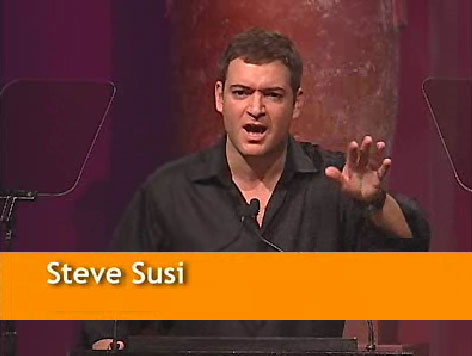
Sunday, April 23, 2006

White. The official color

of Gen-X yuppies. No, not skin color. Brand color.

Thank the iPod, the little device that could. And did.

This machine's proof-positive that certain brands travel in packs. Apple, Volkswagen, J.Crew, Puma — look at ANYTHING any of these companies (and others) have marketed in the past year and I bet you’ll see something that looks straight out of Warhol’s White-on-White period. Interesting, as they all share the exact same target demographics. Hmmm.

“Vacant, vacuous Hollywood was everything I ever wanted to mold my life into. Plastic. White-on-white.”
—Andy Warhol and Pat Hackett, Popism

The Gap's in-house agency could've made that quote. In fact, their addiction to the white stuff pre-dated the iPod (i.e., their late-90s/early-00s campaigns). But it took the iPod to inseminate the global "cool" culture with white. My guess is that it's the result of a Holy Trinity effect that manufacturers/marketers of any product anywhere would do anything to have happen to them — the combination of Apple's effective marketing visuals à la TBWA/Chiat/Day (contrasting the white machine and earphone cord against the black silhouette of the listener); the fact that they're EVERYWHERE today (easily noticed because the white sticks out like a sore jog-wheel thumb); and that the product is effin' great.

Not only has the iPod mutated the music and computer industries in its wake, but fashion and advertising too. Everything’s gone white.

White shoes and suits are no longer the domain of used car hucksters or lounge lizards. And it ain’t just for after Memorial Day anymore. Anything with wires inside seems to be white outside. Every VW you've seen in the last two TV campaigns has been white. Every :15 spot comprising the latest Puma TV campaign is set in a white seamless soundstage using white stage props.

The iPod has done this, and I find that incredible. White is now the new black (high fashion) or silver (high technology). Something as out-of-nowhere as a portable MP3 player has now made the distinct lack of color THE color. And the yuppie-friendly brands which all chase me (yes, I’m a slobbering fan of all of them) have blindly followed suit.

Come on, guys. Have some guts. Use your intuition. Find some calling card of your own. The iPod’s amazing success has made a cottage industry of white paint, but it’s whitewashing (er, homogenizing) message-senders and their wares. It’s almost embarrassing to me as a marketer to witness these amazing marques all coalescing to capitalize on the “idea of white” begun by Apple, the king brand of all VW-drivin, soccer-lovin, Puma-wearin, Europe-travelin, slightly artsy yet safe clothes and hairdo and music-ownin Gen-Xers.

Again, I hate to admit that I’m one of them. Which may have been why I was recently asked by someone who doesn’t even work in commercial communications, “Why do you think so many Apple users drive VWs?” His consumer intuition spider-sense was right on. And the riot of white that’s ensued has only made the ugly truth of bedfellow-brand-imitation more obvious.

Come to think of it, sheep are white.

Wednesday, April 19, 2006

Another speaking engagement —


and this time, at the incredible Phoenician Resort in Scottsdale for the AAAA Management Conference for Agency CEOs.

No, I didn't win a contest in hell and become an agency CEO.

And yes, a certain luxury auto manufacturer has been keeping us busier than a shredder at BALCO; but not so much so I couldn't accept the invitation. The Phoenician is amazing, and our moderator Mike Donahue is cool as hell and has so much ad industry experience that I walk away 32% wiser every time we talk.

As well, you should know that a branding discussion this was not. My onlookers were CEOs, and as such, weren't jonesing for the latest creative tactics per se. Rather, I figured they'd respond stronger to a more holistic view of creative — a service offering that drives ROI and upsells clients.

Nauseate by viewing my opening remarks. (For some reason, Firefox doesn't agree with this link.)

Tuesday, January 24, 2006

Back to the

surface, finally.

Six weeks, a product launch, a couple major holidays, and over 15,000 flight miles ago began The Attack of the Workload.

Oh, and lest I forget the North American International Auto Show in balmy Detroit.

The Auto Show punched me with the power of brand. Wanna watch people OVERLOOK or JUSTIFY really bad product design to avoid disparaging their favorite marque? Go to an auto show. How about watching millionaire 60 year-olds run like pre-schoolers on Christmas morning to a long-awaited line addition? Get thee to Detroit in January.

Want to be threatened with violence for disallowing a show attendee from opening and sitting in one of your floor models? Come and stand next to me at the next NAIAS. (No joke — a giant dude gilded in bling and an ill-fitting track suit told me to get out of his way "or else.")

Click the link above and scroll until you find proof of the mass hysteria paid to the new Camaro concept. Don't TELL me brands aren't powerful aphrodysiacs. Hell, I thought the throng had just discovered a living, breathing alien.

More than a few dozen of the people with whom I spoke drove over from Canada or up from various Southern states, flew from way out West — even traveled from Japan — just to be among the first to witness the unveiling of one of my clients' new models.

In the dank cold of the Upper Midwest, just a month after the mass brand agnosticism that are the Holidays, and in the thorough financial exhaustion of January, the power of brand was alive, well, and wearing Fila.

Sunday, November 13, 2005

The ad:tech Conference here

was a blast. It was my first time to speak and act as a panelist, and my three co-panelists -- Tom Ajello of Agency.com, Lars Bastholm from AKQA, and Jeff Benjamin of CP+B -- and moderator Mike Donahue of the AAAA were cool and fun to speak with. And smart as hell, each of 'em.

I hope I get another chance.

Wednesday, October 26, 2005

Where would you place

the line of accountability among the advertiser, the publisher, and, say, your third-party rich-media vendors?

The first line of accountability rests upon the data and influence gained during the consumer dialogue. Some just post a privacy policy, some call it ‘data transparency,’ others call it responsible business. A few years ago most everyone began asking users to opt in. Later, with the failed credibility of corporate America and the ongoing media hunt for suspect data usage, it’s more than courteous. It’s obligatory.

Now we see that any time the user steps in or around something we create, it’s more probable that they’ll be irritated than turned on. Thus, everyone on the team must understand the end-objective and build an atmosphere that (with luck and talent) reliably spits out brilliance.

The second line of accountability is toward each link of the client-agency-publisher chain, with an eye on strong relationships along the continuum. This is critical, because when something breaks, no one will pass the buck and most will cooperate in the all-hands-on-deck scenario. Without real shared responsibility, there’s only one true loser: the brand.

Popular logic states that company personnel, at the end of the day, need only feel accountable to their employer. Winning logic states that company personnel should act in the interest of their employer, which makes vital the cooperation among the publisher and the agency and the ad hosts and the IT groups and, of course, the client.

When this happens, you’ll notice the first line of responsibility is somehow automatically fulfilled.